Discover how and where SDSS is supporting researchers and public institutions
to study, document, and conserve the underwater cultural heritage.
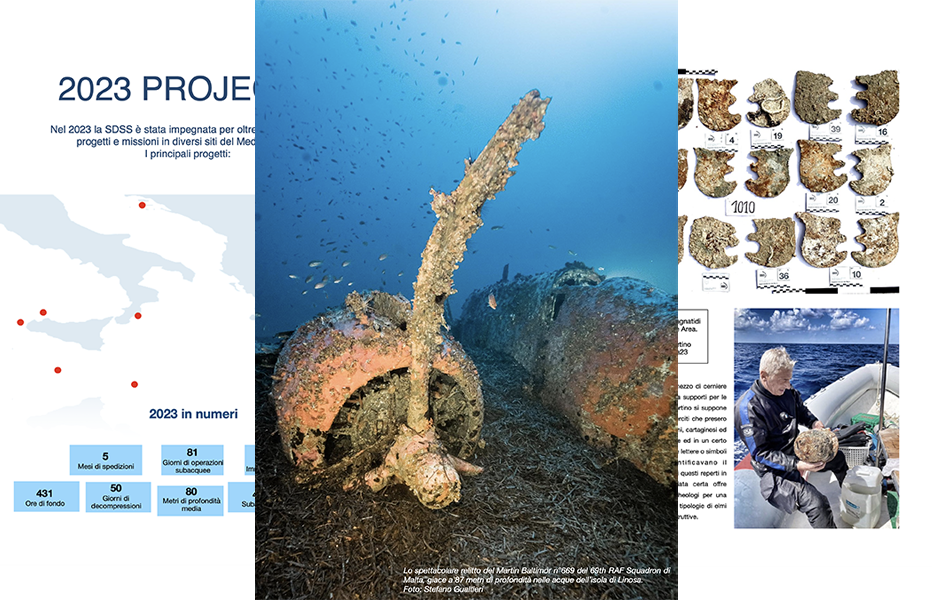
During WW2, the Central Mediterranean Sea was the theater of a long and dramatic fight between the Italo-German and the British Commonwealth naval and air forces. The three-year struggle was aimed, on both sides, at securing their supply lines and disrupting those of the enemy. Dozens of ships and hundreds of aircraft were sunk during 38 months of uninterrupted fighting.
The Battle of the Aegates/Battle of the Egadi was a naval battle fought on 10 March 241 BC between the fleets of Carthage and Rome during the First Punic War. It took place among the Aegates Islands, off the western coast of Sicily. It was the decisive engagement that ended a 23-year-long war and gave Rome supremacy over the Mediterranean Sea.
Something quite big must have happened along the NE coast of Pantelleria island 2200 years ago. The seafloor between Gadir and Tramontana coves, a little more than a mile of coast, was literally covered by archaeological remains. Until the 60’s the coastal shallow waters were carpeted with Carthaginian amphorae.
The archipelago of the Aeolian Islands in the South Tyrrhenian Sea figured prominently in ancient civilization. Their strategic position was contested by the central cultures of ancient times, and their waters were central to merchant traffic, piracy, and naval warfare. The seafloor of the archipelago is rich in distinctive remains of ancient maritime activity.
Shipwrecks are part of the marine landscape, historical sites that have evolved into living reefs. Over time, they become habitats for diverse marine species, while sometimes also presenting environmental challenges such as trapped fishing gear or long-term pollution risks. At SDSS, we approach underwater heritage with this full reality in mind, combining documentation with practical conservation work. By collaborating with scientific and environmental partners, we help protect both the cultural value of wreck sites and the ecosystems that have formed around them. Learn more about how our work connects marine conservation with underwater heritage protection.
Our collaboration with DAN Europe Research Foundation has been ongoing for many years and has progressively developed into increasingly ambitious projects dedicated to the study of diving physiology.